
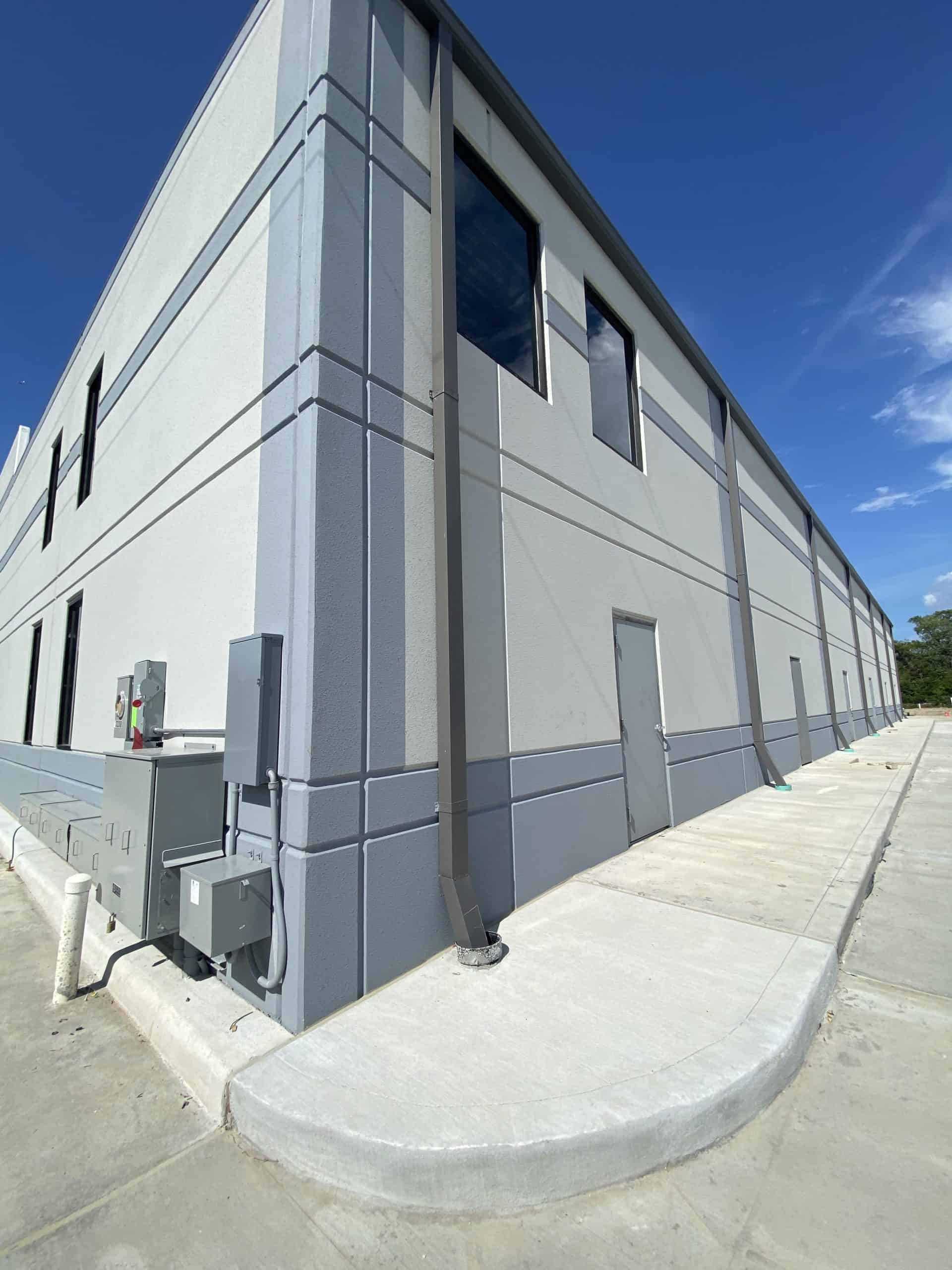
Commercial gutters and downspouts have to be sized for a large roof area and Houston’s intense downpours, built from heavier metal than residential gutters, and set up to discharge where water will not flood an entrance, sheet across a sidewalk or wash out a planter bed. Which system fits depends on the roof. Pitched roofs with an open eave usually get oversized K-style or box gutters. Flat and low-slope roofs behind parapet walls drain through scuppers into conductor heads and downspouts, with separate overflow scuppers as a backup.
Most commercial drainage problems come down to three things: gutters and downspouts too small for the roof they serve, debris from trees and rooftop work that blocks outlets, and downspouts that dump water in the wrong place. Get those right and the system runs quietly with routine cleaning.
Choosing a system: K-style, box gutters and scuppers
Commercial K-style gutters
K-style is the familiar residential profile, made larger and from thicker coil for commercial work. It suits strip centers, offices and churches with sloped roofs and a fascia to hang on. It is seamless and easy to service, but even large sizes can only drain so much roof per outlet.
Box gutters
Box gutters are rectangular troughs, either hung on the outside of the building or built into the roof edge. Because they are custom-fabricated from flat sheet, they can be made wide and deep enough to handle long runs on warehouses, metal buildings and large sloped roofs.
Scuppers and conductor heads on flat roofs
On a flat or low-slope roof surrounded by a parapet, water leaves through scuppers, which are openings through the parapet wall lined with sheet metal. Each primary scupper feeds a conductor head, a collector box on the outside of the wall that slows the water and funnels it into a downspout. Interior roof drains are another option, but those fall under plumbing, not sheet metal.
Parapets also create a risk: if the primary outlets clog, the roof fills like a pan. The International Building Code (2021, Section 1502) requires secondary emergency overflow drains or scuppers where roof drains are required and the perimeter construction would trap water if the primary drains back up. Overflow scuppers must be sized and set so ponding does not exceed what the roof was designed for, must not have an opening dimension of less than 4 inches, and are sized without counting on the primary system. Check which code edition and local amendments your city has adopted, and have the design confirmed by the building’s engineer or architect.
| System | Best for | Strengths | Watch for |
|---|---|---|---|
| Commercial K-style | Sloped roofs with a fascia | Seamless, fast to install, easy to maintain | Capacity limits on big roof areas |
| Box gutters | Warehouses, metal buildings, long eaves | High capacity, custom sizes, heavy gauge | Built-in versions can leak into the building if joints fail |
| Scuppers and conductor heads | Flat or low-slope roofs with parapets | Drain through the wall, keep the roof edge clean | Need overflow scuppers; outlets clog with debris |
Sizing commercial gutters for large roof areas
Residential rules of thumb do not scale up to a commercial roof. The standard method comes from SMACNA’s Architectural Sheet Metal Manual, and SMACNA’s free downspout and gutter sizing calculator shows what goes into it: the local rainfall intensity for a short, severe storm, the roof area draining to each gutter, the number and length of gutter sections, the number of downspouts, and the gutter’s width-to-height ratio. It also accounts for vertical walls that shed water onto the roof, which matters on buildings where a taller wall section rises above a lower roof.
A few practical points for commercial gutters in Houston:
- Design for the downpour, not the average rain. Our storms dump a lot of water in a short time, and that peak flow is what overflows a gutter.
- Count roof area by drainage zone. A roof that slopes to one side sends all of its water to one gutter line.
- More outlets beat a bigger trough. Adding downspouts shortens how far water travels in the gutter and often solves overflow more cheaply than upsizing.
- Add the wall area from any taller walls that drain onto the roof.
Heavier gauges and stronger hangers
Commercial gutters take more abuse: longer spans, heavier water and debris loads, service crews’ ladders and the occasional delivery truck. Thicker aluminum or steel, closer hanger spacing and heavy-duty brackets keep the run straight and holding its slope. The International Building Code also requires gutters and leaders on the outside of most buildings other than houses, private garages and Type V wood-frame construction to be noncombustible material or at least Schedule 40 plastic pipe, which in practice means metal for most commercial projects.
Commercial downspouts: capacity and where the water goes
A gutter only works as well as its downspouts. On commercial buildings, larger rectangular downspouts carry far more water than small residential ones and are less likely to clog with leaves and debris. Our box and drop downspout installation covers both the downspouts and the drop outlets that connect them to the gutter.
Where the water ends up matters just as much, especially on properties with public foot traffic:
- Do not discharge across sidewalks, entrances, ADA routes or drive-through lanes. Constantly wet concrete grows algae in our humidity and becomes a slip hazard.
- Tie into the site’s storm drainage where it exists and the local rules allow it.
- Where downspouts drain onto pavement, direct the flow toward a drain or curb line, not toward parking stalls or the building.
- Keep water away from foundations. Houston’s expansive clay soils swell when soaked and shrink when dry, and concentrated discharge next to a slab makes that worse.
- Protect downspouts near loading docks and drive lanes with guards or bollards. A crushed downspout backs water up into the gutter.
How coping caps and edge metal tie into the drainage
The metal at the top and edge of a commercial roof is part of the drainage system, not just trim. On parapet walls, coping caps shed water off the top of the wall instead of letting it soak into the masonry, and properly installed coping is sloped to send that water back toward the roof, where the scuppers and drains can handle it. Joints in the coping need cleats and sealant so water does not get behind the cap and run down inside the wall. Our coping cap installation page covers that work.
On roofs that drain to a gutter, the edge metal or drip edge has to lap into the gutter so water lands in the trough rather than running behind it and rotting the fascia or staining the wall. At scuppers, the sheet metal lining has to be flashed into the roof membrane and the parapet so the opening itself does not leak. Get those details wrong and the gutters get blamed for leaks they did not cause.
Maintenance schedule for commercial gutters and downspouts
The National Roofing Contractors Association recommends that owners inspect roof systems at least twice a year, preferably in spring and fall, with additional inspections after severe weather, and paying special attention to valleys, gutters and roof drains where debris collects. For Houston-area buildings, a workable plan looks like this:
- Spring: clear oak pollen strands and spring leaf drop, and check that downspouts flow freely before the rainy months.
- Before and during hurricane season (June 1 through November 30): clean gutters and scuppers, secure loose sections and confirm that overflow scuppers are open.
- Fall: clear leaves and pine needles, and look for sagging, rust at seams and separated joints.
- After any big storm: walk the building and look for overflow stains, bent downspouts and debris at outlets.
- After rooftop HVAC or other trade work: check for screws, sheet metal scraps, filters and packaging left near drains and scuppers. A single filter box can block a conductor head.
Buildings under heavy tree cover may need more frequent cleanings.
Signs your commercial gutters need repair
- Water sheeting over the front of the gutter during moderate rain
- Streaks or stains on the wall below gutters, scuppers or conductor heads
- Rust lines along seams, end caps or the bottom of steel gutters
- Sagging runs, loose hangers or gutters pulling away from the fascia
- Overflow scuppers running in ordinary storms, which usually means the primary outlets are blocked
- Ponding on a flat roof near drains or scuppers long after the rain stops
- Washed-out soil, puddles or algae where downspouts discharge
- Interior leaks along parapet walls or at the roof edge
When drainage problems come with damaged roof panels, loose edge metal or roof leaks, handle them together. That is where commercial metal roof repair comes in alongside Houston commercial gutter repair.
Frequently asked questions
A scupper is the opening through a parapet wall that lets water off a flat roof. A conductor head is the metal box mounted on the outside of the wall just below the scupper. It collects the water, slows it down and feeds it into the downspout. Overflow scuppers usually discharge freely without a conductor head so that it is obvious when they are running.
Often, yes. Gutter capacity depends partly on how far water has to travel to reach an outlet, so adding outlets and downspouts can fix overflow on a run that is otherwise sound. It depends on whether there is a sensible place to discharge the extra water and whether the gutter itself is in good shape. A sizing check against the roof area tells you which option makes sense.
At least twice a year for most buildings, with extra cleanings for properties under oaks or pines and after major storms. Buildings with frequent rooftop equipment service should also be checked after contractors finish, since screws, filters and packaging end up in gutters and scuppers. A short visual check after heavy rain catches most problems before they cause leaks.
Both are used. Heavy-gauge aluminum resists rust, is lighter on the structure and works well for seamless K-style runs. Steel is stiffer and more dent resistant, which helps on box gutters and in high-traffic areas. The roof and edge metals matter too, since mixing incompatible metals causes galvanic corrosion. The right choice depends on the building, the roof material and the exposure.
Get a quote
We work on commercial gutters and downspouts across Houston and Harris County, from Pasadena to the northwest suburbs. Call 832-605-3397 or request a quote to have someone look at your building’s drainage.